Looking for a plumber in Durban who names the fault before quoting on it? Most of what fails in this city can be traced to a network that empties and refills on a schedule. We start by working out which of your problems is yours and which one belongs to the street.
Tell us the symptom and the suburb. You get the call-out figure and what it covers before anyone is sent, so there is nothing to argue about afterwards.

There are two ways to run a plumbing call. One is to arrive, do something, and leave a number on a page. The other is to say what the fault is, say how that was established, price the fix, and hand over paperwork that survives being read by an insurer or a landlord. This site is built around the second.
That matters in Durban more than it does in a city with a steady supply. When the network empties and refills daily, the same house can produce a knocking pipe, a weeping geyser and a blocked mixer inside a month, and those look like three faults and three invoices. Quite often they are one cause. Knowing that is the difference between fixing the problem and being billed for the symptoms one at a time.
Domestic and commercial plumbing across the metro. Each of these has its own page with the detail on it, including how the job is priced.
A line that will not stop running, a ceiling coming down, or a geyser that went while nobody was home.
A meter that turns with every tap closed. Traced with equipment rather than by opening walls to look.
No hot water, lukewarm water, a dripping overflow or a tank that has started to seep at a seam.
Replacement done to the standard, with the certificate issued and in your hands the same day.
Hobs, water heaters and bottle installations, and the gas certificate your insurer will ask for.
Toilets, gullies and sewer runs cleared, and a straight answer on whose side of the boundary it is.
Footage and a located depth, which is what a landlord, an insurer or a neighbour will actually accept.
Shell, plumbing or evaporation. Established before anyone drains the pool or breaks the surround.
Pressure valves, corroded supply runs and booster sets, once we have ruled out the supply schedule.
The plumbing behind a renovation, pressure tested and signed off before the tiler covers it up.
Body corporates, retail and light industrial, including storage sizing for a rationed supply zone.
What the trade's own guide figures are, what the call-out covers, and why a short job can bill an hour.
In April 2022 a rock fall destroyed two of the four aqueducts at Molweni that carry raw water from Nagle Dam to the Durban Heights treatment works. The metro lost roughly 280 megalitres a day in one go. Everything about how water reaches a Durban property since then follows from that morning.
eThekwini has managed the shortfall by rationing, which means closing and throttling rather than simply supplying less. Published windows have run from 10am to 3pm and 8pm to 4am in the south and south west, with parts of Westville off from 8pm to 5am, while Northdene 3's inlet has been throttled to 15% with the reservoirs below it opening for about three hours twice a day. The City's own explanation is the honest one: rationing is done to build storage, and water is reopened when levels allow.
Here is the part nobody mentions when they come to fix your tap. A main that empties does not sit there full of nothing. It fills with air, and when supply returns that air has to be pushed out through whatever is downstream of it. When Reservoir 3 at Durban Heights was recommissioned, 72 air valves along the 32km line to Phoenix were damaged, and the City linked it to the volume of air entering the pipelines. It ordered 60 replacements.
Those were engineered steel valves on a bulk main. Your house has 15mm copper, a geyser with two small vacuum breakers, and a washing machine with a plastic solenoid. The same refill reaches all of it, carrying a slug of air that slams when it finally clears, grit scoured off the inside of the pipe wall, and a pressure spike at the instant the void closes. That is why Durban plumbing produces knocking on refill, blocked aerators and mixer cartridges, dead appliance inlet valves, and geysers that start weeping days after an outage rather than during one.
So the cheapest thing you can do costs nothing. When supply comes back, open the lowest and furthest cold tap in the house first, and open it slowly, so the air leaves through a tap instead of through your geyser. After that, the two things worth having checked on a rationed zone are the pressure control valve and whether the geyser's vacuum breakers are actually venting, because both exist for precisely this and both fail quietly.
Any of these point at the supply cycle rather than at a fault that started on its own.
Four commitments about method. They are things we control, which is why they can be stated plainly.
If we cannot get there today you are told so straight away, and talked through shutting it down in the meantime.
What the call-out covers and what the work will cost, agreed before anyone starts, not presented afterwards.
An itemised invoice, and where the work needs one, the certificate. Not something to chase for a month.
On an emergency request the first thing we do is tell you how to stop it, before anyone leaves to come out.
Read the emergency pageCommon symptoms in this city, what each one normally means, and what it actually needs. Nothing here is a case study, because this site does not claim a history it has not got.
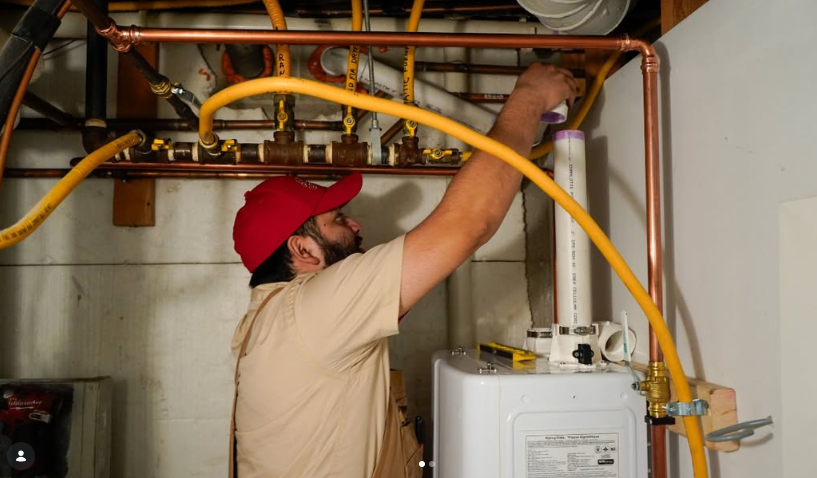
Overflow pipe dripping outside. Usually the temperature and pressure valve doing its job against pressure it should not be seeing, or a valve that has taken grit and no longer seats. Needs the incoming pressure measured before anything is replaced, because swapping the valve treats the symptom.
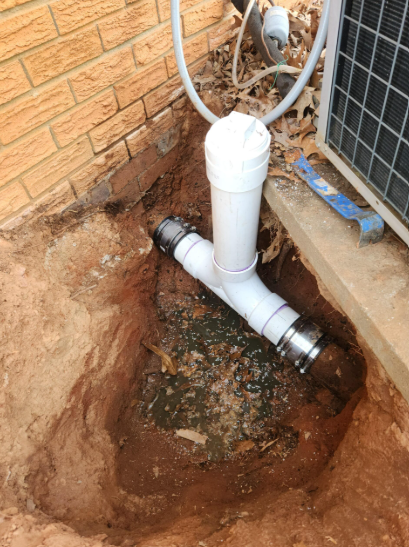
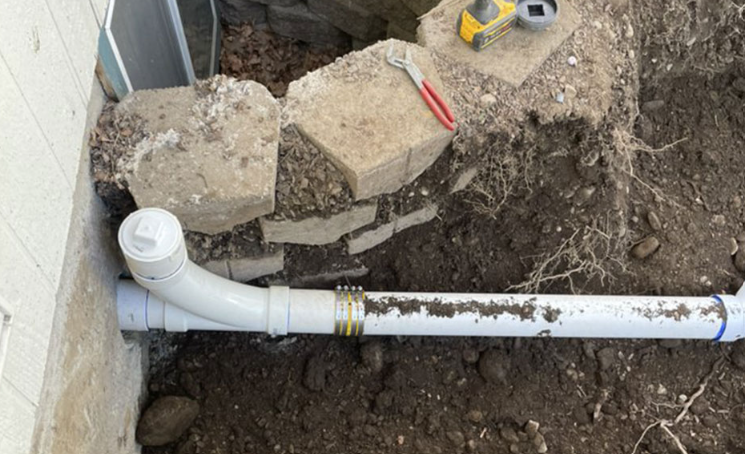
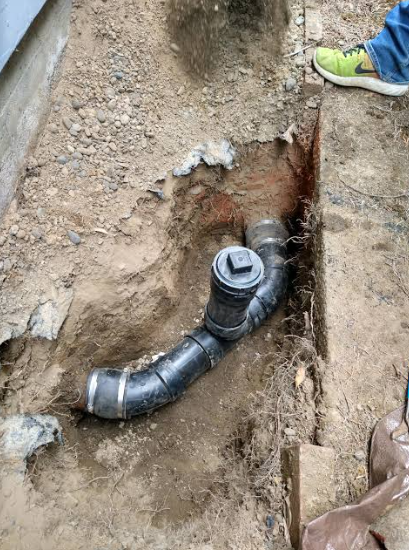
Every drain in the house slow at once. Rarely a blockage under a basin. When all of them go together the restriction is downstream, at the gully or in the connection to the main sewer, and that is also where the boundary question starts. Needs a camera before a price, not after.
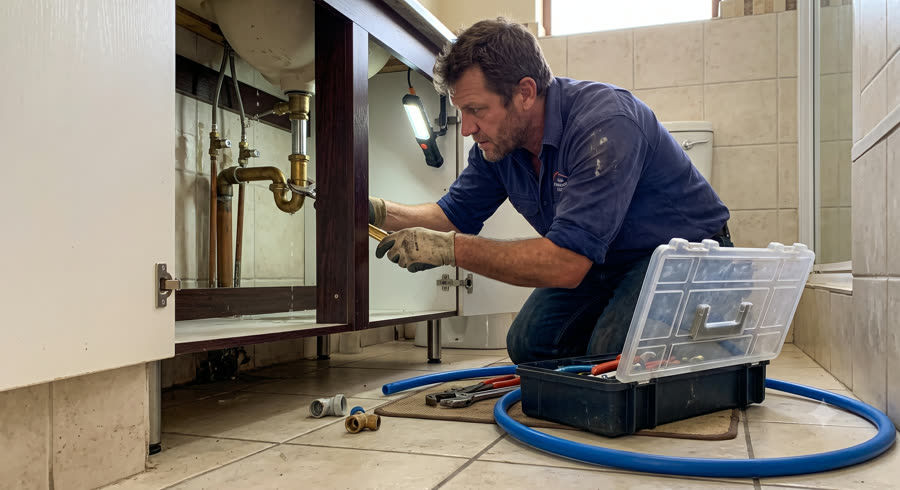
Meter creeping with every tap shut. Something past the connection point is running, and on a property with a buried supply run it is usually a pinhole rather than a burst. Needs tracing before digging. The municipal loss figure is not yours, but everything after the meter is.
The supply picture is not the same across the metro, so each of these has its own page with what applies locally.
On the 27km line that lost supply to valve damage and vandalism, with a two day refill.
Same line, newer stock, and a lot of plumbing that has never been tested by an outage.
The end of the 32km run from Durban Heights, and where the 72 air valves went.
Named in the published rationing schedule, off from 8pm to 5am.
Inner west, older reticulation, and industry sharing a sewer network with housing.
Upper Highway, on a works the City names for fats, oils and grease.
Below a reservoir throttled to 15%, with outlets open about three hours twice a day.
South coast, on a works that takes industrial load from Prospecton.
A different municipality and a different dam, growing faster than either.
The price questions first, because that is what everyone actually arrived wanting to know.
The Institute of Plumbing South Africa publishes guide figures the whole trade works from: a call-out fee of R450 to R650, and labour at R450 to R850 an hour, averaging about R650. Both exclude VAT, and both exclude whatever parts the job needs. Those are national guidelines rather than a tariff, so treat them as the shape of a fair bill and not as a fixed price. The part that catches people is the phrase attached to the hourly figure, which is or part thereof, and it is why twenty minutes of work can arrive on the invoice as an hour.
Because the pipe was empty and has just refilled. eThekwini rations supply in windows to rebuild reservoir storage, so a great many Durban properties drain down and fill up again on a daily cycle. Air gets in while the main is empty, and when the refill finally pushes that air through a bend or a closing tap it arrives as a bang. It is not cosmetic. The same slug of air is what destroyed 72 air valves on the City's own bulk line to Phoenix, and a house has nothing as strong as those valves.
That depends on what is being asked for and it is settled before anyone comes out, not on your doorstep. Looking at a job and pricing the work is one thing. Diagnostic work is another, because tracing a leak under a slab or putting a camera down a drain is the service itself and takes equipment and time. We tell you which of the two your job is before anyone is dispatched, along with the figure, so nothing on the invoice is a surprise.
Very often, yes, and the delay is the confusing part. A geyser that has been sitting empty or part empty takes the refill through its inlet, its vacuum breakers and its element seat all at once. Nothing has to fail at that moment. A seal that took the shock can weep days later, and a tank that lost its lining protection can start seeping from a seam well after the event that caused it. Geyser repair in this city is very often the delayed bill for something that happened during an outage.
Not by itself, and this is worth being precise about. eThekwini's non-revenue water has run above 50% and was reported at 65% for June 2026, against an accepted norm of 15% to 30%. But almost all of that loss sits upstream of your meter, on the City's side, and it is not charged to you. The losses you pay for are the ones after your connection point. That is the whole argument for leak detection: the municipal figure is not your problem, and anything past the meter is.
We publish what happens rather than a slogan. Out of hours a request reaches a person who will tell you honestly whether someone is coming tonight or first thing, and if the answer is first thing you get talked through shutting the water off and limiting the damage in the meantime. A straight answer at ten at night is worth considerably more than a promise of twenty-four hour cover that turns into an argument. Our published hours sit in the footer, and the emergency page sets out what to do while you wait.
Durban proper and out through the metro: Durban North, Umhlanga, Phoenix, Westville, Pinetown, Hillcrest, Chatsworth and Amanzimtoti, plus Ballito up the North Coast. Travel is what the call-out fee covers, so ask in your request and we will tell you what it is for your address before anybody sets off.
Get In Touch
Tell us what is happening and which suburb you are in. You get the call-out figure and what it covers before anyone is dispatched.
